






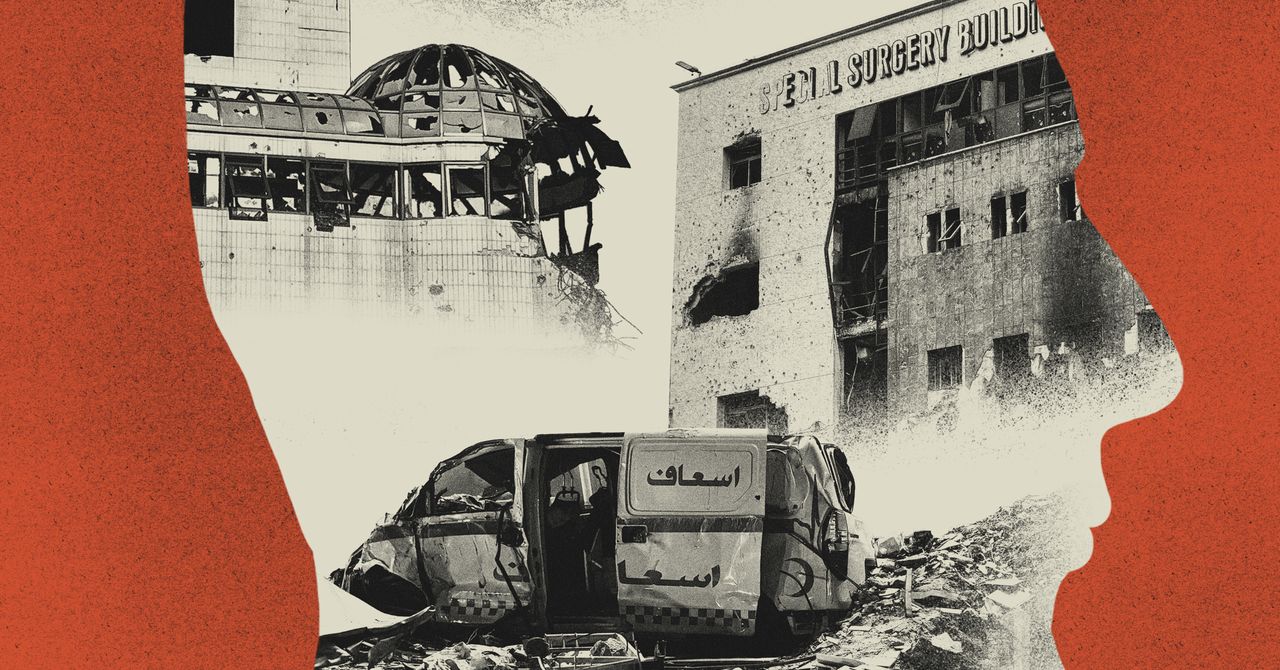
In early December, Ahmed recalls, “we heard tanks advancing from the edge of the yellow line.” Soon, a 14-year-old girl was rushed into the ICU with a shrapnel wound to the abdomen. The girl needed 250 milliliters of blood, “a precious resource” at Al-Shifa, and a splenectomy. Even with minimal supplies, even amid an attack that was not supposed to happen, the doctors at Al-Shifa saved her life.
By the time Ahmed left, the girl was discharged, “smiling.” Her wounds were so severe that the doctors used some of their gauze allotment on her. But the girl had no choice but to return to her family’s tent, hardly a stable environment for recovery. Even before she was admitted to Al-Shifa, she was “so malnourished.” The return of some amounts of food to the shelves has been little help to her family, who cannot afford to pay inflationary prices. Ahmed, full of worry for the girl, remains in touch.
On December 11, Ahmed recorded a four-minute voice note to memorialize her thoughts on her last day in Gaza. In the background, she points out, are bulldozers. Rescue teams took advantage of the relative calm to exhume the courtyard, which has become a grave of necessity for untold numbers of people at Al-Shifa. “The smell of death is literal, in this case,” she says on the voice memo. An Al Jazeera story from three days earlier reported that the Palestinian Red Crescent had recovered 150 bodies.
“This hospital is haunted by all these stories of people that were killed, and then all of the stories that are now being told, because we have a little bit of space and time to hear them, about what happened to people,” Ahmed says. “It’s not just the campus in Al-Shifa. It’s everywhere in Gaza.”
Along with the assaults on Palestinian life, health, and movement comes an assault on what remains of their sovereignty. The Israeli government in recent months has opened the floodgates to both state and settler seizures of West Bank land. President Trump has established a “Board of Peace” to rule Gaza, beginning with the construction of a 350-acre military base to station 5,000 troops.
The declaration of a ceasefire, however one-sided, has prompted many, particularly in the United States, to move on. Sidhwa, the California trauma surgeon, says this “ is a total disaster—it means the Palestinians are going to be destroyed in Gaza.” As Israel’s accomplice, supplying it arms and diplomatic cover during the genocide, the United States is also the only potential check on its behavior. “It’s very dispiriting that we don’t have a political culture or a media culture, or even the moral culture, to recognize that we should care about our own crimes,” Sidhwa says.
But Gaza is more than a crime scene. “Obviously, much of it is destroyed, but Gaza City is beautiful, the people are beautiful,” Thorburn says. At Al-Ahli, she lived with 10 young women in their twenties. They were nurses, radiology technicians, medical students, lab techs. They took Thorburn to the beach to watch people fish—a dangerous activity with the Israeli navy offshore—enjoy a picnic with what food they had, and otherwise do “their very best to live a normal life.” Resisting the attempts to rip them apart, they weaved themselves together, each reinforcing the others, like gauze.