Key Takeaways
- Grayscale projects ETH inflation could fall to 0.4% and SOL to 1.1% annually by 2031 under two pending proposals.
- Ethereum’s EIP-8361 and Solana’s SIMD-0550/0553 target validator rewards and fee burns starting in 2026.
- Grayscale’s Zach Pandl says Solana’s plan has broader community support and better odds than Ethereum’s counterpart.
Two Networks, One Scarcity Bet
Ethereum and Solana are each weighing tokenomics overhauls that, according to a new Grayscale research note, could make both networks scarcer than gold within five years. The asset manager estimates that if the proposals go live as written, Ethereum’s (ETH) annual supply growth would fall to about 0.4% by 2031, while Solana’s (SOL) would settle near 1.1% (both undercutting gold’s roughly 1.8% yearly supply growth and comfortably below the U.S. Consumer Price Index’s 3.3% inflation reading).
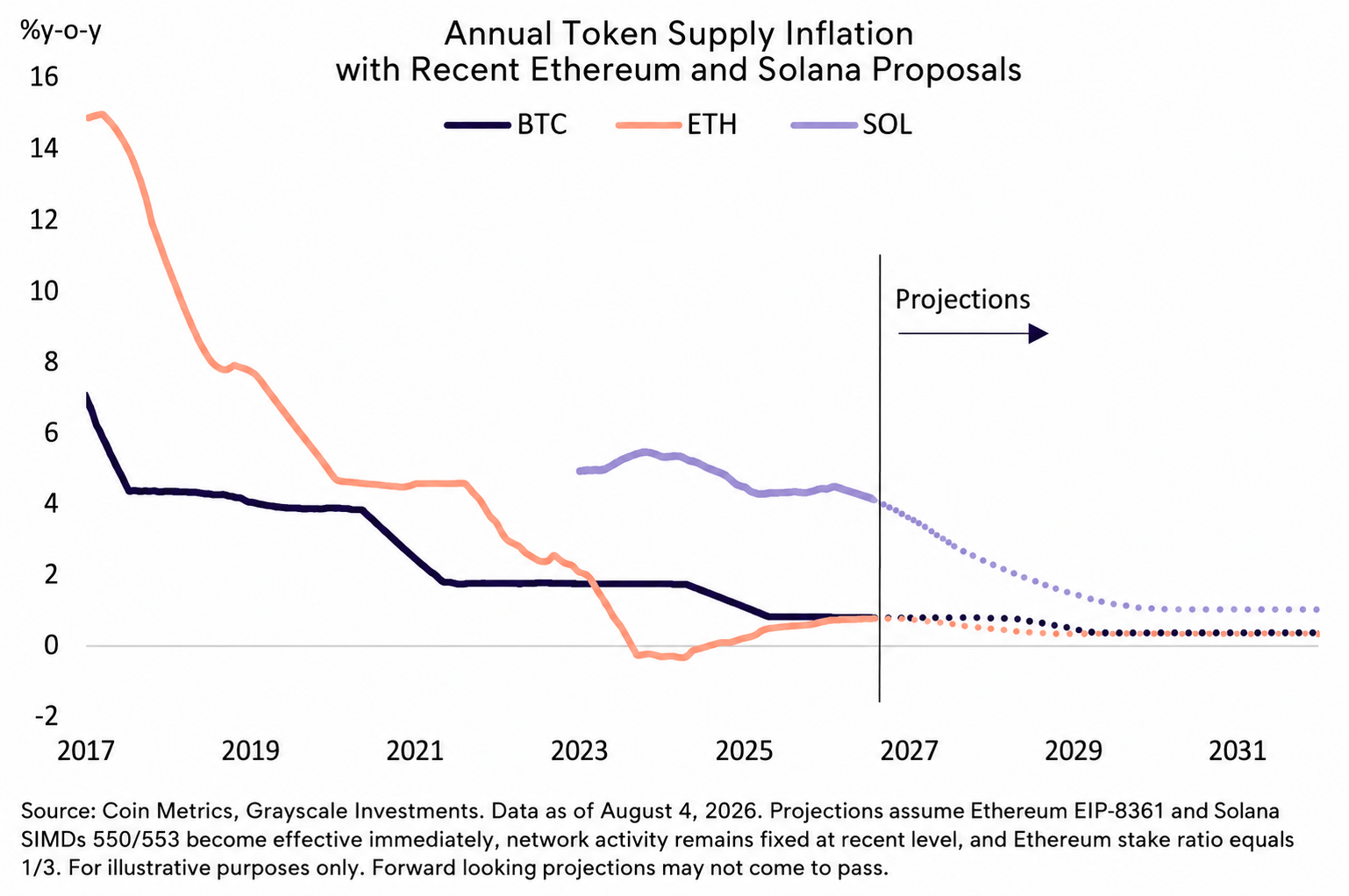
For comparison, bitcoin’s own issuance schedule is already tracking toward a similar 0.4% rate by the same year.
The pitch behind both proposals is simple, i.e., slow the pace at which new tokens hit circulating supply, and scarcity should, in theory, support prices even as reward yields for validators and stakers shrink.
How Ethereum’s ‘Tapered Issuance’ Would Work
Ethereum’s version is Ethereum Improvement Proposal 8361 (EIP-8361), nicknamed “Tapered Issuance Burn.” It was submitted for community review on August 4 by six authors, including Ethereum Foundation researcher Justin Drake. Under current rules, validators can still earn close to 1.5% in annual staking rewards even in a scenario where nearly all ETH is staked, a ceiling they say oversupplies the network with new coins regardless of actual demand for security.
EIP-8361 would instead burn a rising share of validator rewards as the staking ratio climbs, phasing that burn to 100% once roughly 60.25 million ETH (about half of today’s supply) is staked, via an 18-month transition. Under the proposal’s own modeling, annual issuance would peak near 0.5% around a 20% staking ratio before declining toward zero as the network approaches that 50% threshold.
Grayscale’s own ETHE fund started distributing staking rewards to shareholders earlier this year, the first U.S. spot crypto ETP to do so, so any structural change to how much ETH validators earn would eventually filter through to what those funds pay out.
Solana’s Two-Pronged Approach
Solana’s path runs through two separate Solana Improvement Documents, namely SIMD-0550 and SIMD-0553. Solana’s inflation currently sits at about 3.695% annually, a rate that already declines 15% every year on its way to a long-term floor of 1.5% under the network’s original disinflationary schedule.
SIMD-0550 would double that yearly decline rate, compressing years of gradual reduction into a shorter runway toward Grayscale’s projected 1.1% by 2031. SIMD-0553 works from the other side, restructuring how transaction fees are burned so more SOL is permanently destroyed rather than recycled to validators.
Grayscale’s note is careful to add that, under current network conditions, the extra burn from SIMD-0553 is still modest compared with daily issuance, meaning SIMD-0550’s faster decline is doing most of the heavy lifting toward that 2031 estimate.
Not a Done Deal Yet
As things stand, nothing is finalized yet as both EIP-8361 and the Solana SIMDs remain proposals working through their respective communities’ governance processes, and Grayscale’s numbers assume the changes take effect immediately and nothing else about network conditions shifts (a scenario the firm itself flags as unlikely to play out exactly as modeled).
Grayscale’s head of research, Zach Pandl, said this week that the two proposals aren’t on equal footing. Pandl believes Solana’s plan has broader support and is more likely to be implemented than Ethereum’s, an aspect that matters for anyone pricing in scarcity before either change is live.
He also noted that a scarcer circulating supply could support prices, potentially offsetting the reduction in staking income for validators and ETF holders alike, a trade-off stakers on both networks will be watching closely as the proposals move through review.