

Gen Z traders on Binance have increased the ETF share of their equity trading volume to 25% in early August as their allocation to individual stocks has declined.
Summary
- ETFs accounted for 21.9% of Gen Z net equity inflows in July, up from 18.5% in June.
- Individual stocks received 74.2% of July inflows, compared with 77% one month earlier.
- Gen Z averaged fewer monthly trades than Millennials and Gen X across the products studied.
- Binance warned that its short direct-equities data window limits conclusions about lasting behavior.
Binance Research found that exchange-traded funds are taking a larger share of Gen Z equity activity across the exchange’s direct-equity, tokenized-stock, and traditional finance perpetual products.
The research compared trading frequency, net capital flows, and leverage use among Gen Z, Millennials, Gen X, and Baby Boomers. While the youngest group increased its ETF allocation, the figures also showed that Gen Z generally traded less often than other working-age generations.
During July, ETFs received 21.9% of Gen Z’s net equity inflows, rising from 18.5% in June. Over the same period, the share directed toward individual stocks fell from 77% to 74.2%.
By early August, ETFs represented 25% of the cohort’s equity trading volume, adding another data point to the increase recorded in July. Binance did not say whether the August share would hold for the entire month.
Gen Z ETF activity rises as trading remains limited
Across traditional finance perpetuals, Gen Z users completed an average of 13 trades per month. Millennials averaged 17, while Gen X recorded 16.5.
Similar patterns appeared across the other equity products included in the study, with Binance finding that Gen Z traded less frequently than the two older working-age groups. The research compared account activity rather than relying only on survey responses about investment preferences.
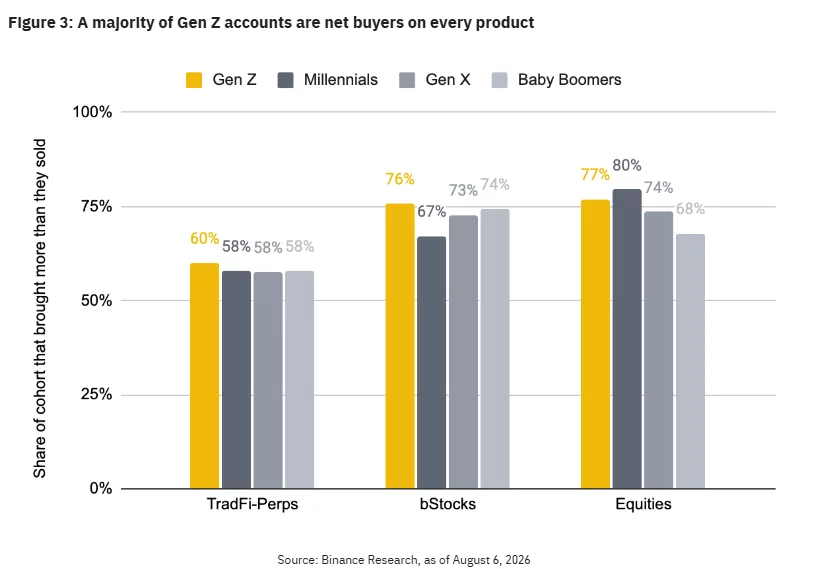
Sell-order data also indicated that part of the cohort was holding positions instead of actively trading in and out of them. Among Gen Z direct-equity accounts, 22% had never submitted a sell order.
The corresponding share stood at 19% for Gen X and 9% for Baby Boomers. Millennials recorded the largest buy-only group; however, 30% of their direct-equity accounts showed no sell orders.
Within the Gen Z buy-only group, Broadcom, Tesla, and the Schwab U.S. Dividend Equity ETF ranked among the leading assets by cumulative purchases. The mix included two U.S.-listed technology companies and an ETF designed to track dividend-paying American stocks.
Binance did not present the buy-only activity as proof of a long-term investment strategy. An account may have avoided selling because it entered the market recently, particularly given the limited operating history of the exchange’s direct-equity product.
Binance data shows limited demand for leveraged ETFs
Leveraged and inverse ETFs attracted little activity from Gen Z users, even though such products can amplify gains or provide exposure to falling markets.
Binance reported that 88.2% of Gen Z traditional finance perpetual accounts had not traded either type of ETF. The inactive share was lower among Millennials at 84.5% and Gen X at 85.9%.
Unlike standard ETFs, leveraged products generally seek to deliver a multiple of an index’s daily move, while inverse funds seek gains when the tracked market falls. Their returns can differ from the index over longer periods because the products reset each day, according to investor guidance from the U.S. Securities and Exchange Commission.
The Binance figures therefore show that the youngest traders in its sample were not using leveraged or inverse funds as frequently as other working-age cohorts. However, the report did not establish whether risk concerns, product awareness, eligibility rules, or other factors caused the difference.
For U.S. investors, the distinction between conventional ETFs and blockchain-based equity products remains important. A traditional ETF registered in the United States trades through regulated securities markets, while a tokenized stock or derivative may only provide economic exposure to the referenced asset.
As crypto.news previously reported, the SEC has warned that third-party stock tokens can carry different rights from conventional shares. Depending on the product’s legal structure, buyers may not receive direct ownership, voting privileges, or the protections available to registered shareholders.
Access also depends on location. Some international tokenized-equity platforms restrict U.S. persons even when their products track stocks or ETFs listed in American markets.
Tokenized stocks bring U.S. equities onto crypto platforms
Binance’s findings arrive as crypto exchanges add more ways for eligible users to trade instruments tied to U.S. stocks and ETFs.
The exchange launched bStocks in June with tokenized versions of Nvidia, Tesla, Circle, Micron, and SanDisk. Binance has said the products are backed on a one-to-one basis by underlying U.S. securities and can be converted into direct stock positions without conversion fees.
During the first nine trading days of Binance’s equities business, daily volume averaged about $143 million, according to research figures cited in an earlier report on the equities product debut. Turnover passed $1 billion, daily active traders peaked at 30,700, and total value locked approached $400 million during the period.
The short operating history also limits the Gen Z study. Binance cautioned that its direct-equities product only reached meaningful scale in June, leaving too little data to determine whether the allocation and trading patterns represent lasting generational behavior.
Elsewhere in the sector, Crypto.com introduced tokenized derivatives tied to 1,500 U.S. stocks and ETFs for eligible users in the European Economic Area and other approved markets. The tokenized derivatives offering includes instruments linked to Apple, Nvidia, Tesla, SPDR Gold Shares, and iShares Silver Trust.
Crypto.com’s products provide synthetic price exposure rather than legal or beneficial ownership of the underlying securities. Eligible users may receive dividend-equivalent adjustments, while the assets supporting the products are held with Alpaca, a U.S.-regulated self-clearing broker-dealer.
Binance bStocks competes with xStocks for second place
Growing interest in equity products has coincided with rapid changes among tokenized-stock issuers. Binance’s bStocks briefly overtook Kraken-backed xStocks this week, less than two months after its launch.
Token Terminal data placed bStocks at $624 million in tokenized stock value on Thursday, ahead of xStocks at $579 million. Ondo Finance remained the largest issuer in the ranking.
By Saturday, their positions had reversed, with xStocks holding $603 million and bStocks falling to $535.1 million. The platforms accounted for about 22.3% and 19.8%, respectively, of the roughly $2.7 billion market tracked by Token Terminal.
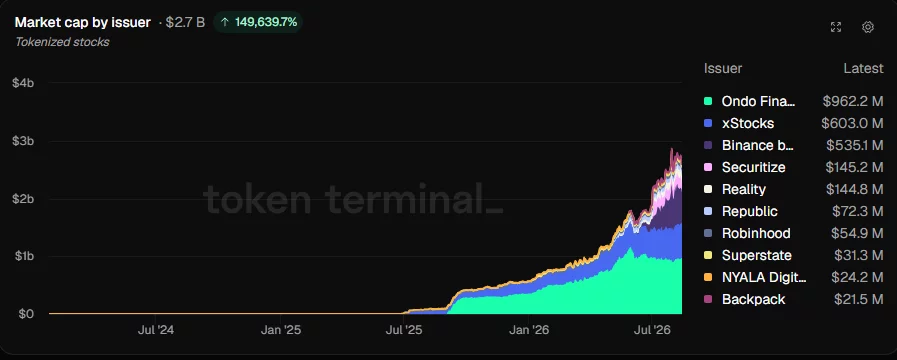
Ondo retained first place with $962.2 million. Earlier in August, bStocks had reached about $624 million, compared with roughly $579 million for xStocks and $927 million for Ondo.
Separate figures from RWA.xyz placed the distributed tokenized-stock value at $2.37 billion as of Saturday, an increase of about 5% over the preceding 30 days. Differences between that total and Token Terminal’s estimate can arise from the platforms, products, and valuation methods included by each data provider.
Tokenized equity adoption had already accelerated before Binance entered the issuer rankings. In July, data shared by DWF Labs showed that the number of holders across five major platforms had risen 92% in 30 days to 752,000, with Robinhood accounting for 328,000 holders and 44% of the measured total.
Robinhood held only $44 million in tokenized stocks in that comparison, while Ondo controlled $857 million and xStocks held $487 million. DWF Labs calculated an average Robinhood position of $134, compared with about $5,900 for Ondo and $1,900 for xStocks.