Key Takeaways
- Four new reactions in 30 days. A Polish Academy of Sciences robot found four previously undescribed enantioselective reactions, making more than 3,000 decisions along the way.
- Reinforcement learning drove the choices. The system decided whether to optimize a hit or move on, after training in a digital twin to save reagents.
- Humans still framed and verified. Researchers set the search space and confirmed the products by hand.
In a Polish Academy of Sciences lab, a robot spent a month chasing enantioselective chemistry and came back with four previously unknown asymmetric reactions. The system ran on reinforcement learning, making more than 3,000 decisions about what to try next, then deciding whether to optimize a hit or move on. Researchers still chose the starting materials, set the candidate space, and did the hard work of characterizing products, a reminder that autonomy in the lab often starts with a tightly drawn box. The work, led by Patryk Klochowicz at the Institute for Organic Chemistry, was published in Nature Communications on 10/13/2026.
Advanced robotics rewrites the pace of discovery
If you’ve been wondering what “AI for science” looks like when it leaves the slide deck, here’s a tangible example. At the Institute of Organic Chemistry at the Polish Academy of Sciences, researchers built a lab robot that didn’t just run a fixed script. In 30 days, the system identified 4 previously undescribed asymmetric chemical reactions by choosing which experiments to pursue next, based on what it had just observed.
The work, published in Nature Communications on October 13, 2026, lands at a moment when US biotech and materials startups are hunting for any edge in wet-lab throughput. This is the case where “automation” is less about speed alone and more about judgment under uncertainty.
Why mirror-image molecules are a hard test for machines
The target wasn’t a simple yes-or-no reaction screen. The team focused on enantioselective chemistry, where products can form as left- and right-handed mirror images, and only one may be desirable. In pharmaceuticals, for example, the wrong “hand” can be inactive or problematic, so scientists care about yield and selectivity at the same time.
That multi-objective tension is exactly what makes this kind of work slow for humans. A condition that produces lots of product might produce the wrong mixture of mirror images, so the next experiment becomes a careful trade-off, not just “try hotter” or “try longer.”
Reinforcement learning, but tethered to real instruments
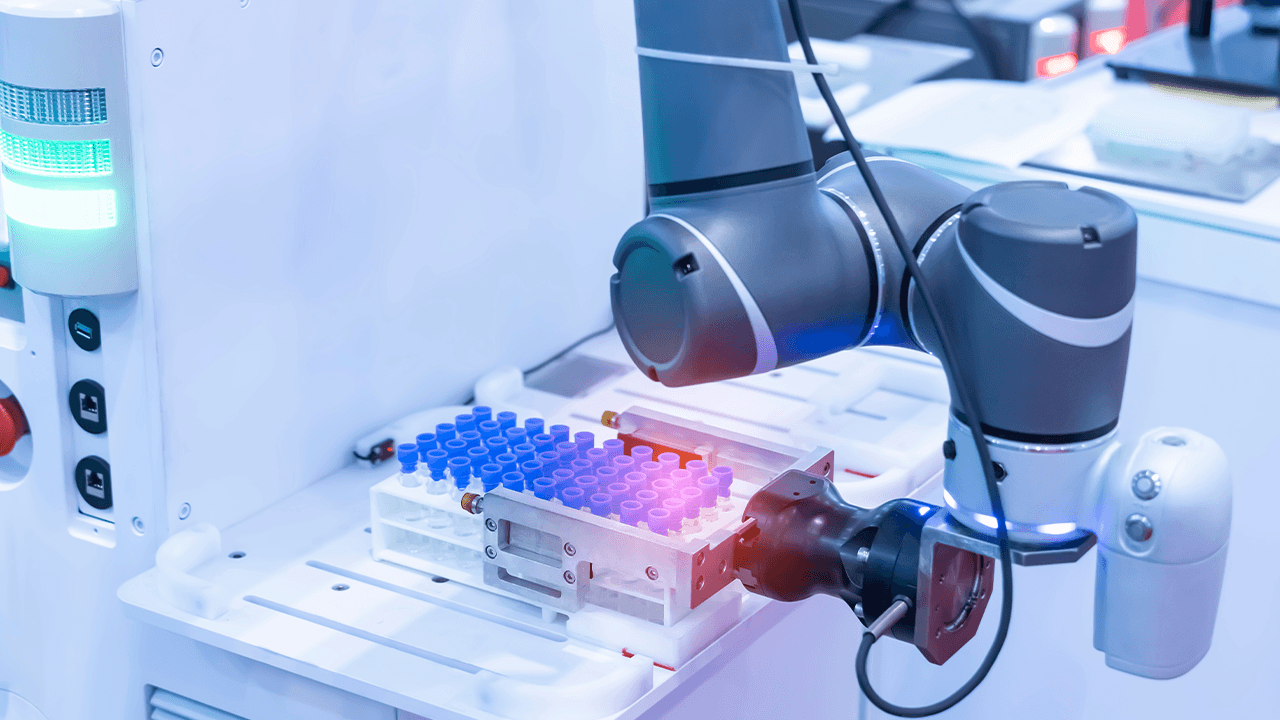
The platform paired practical hardware, dosing systems, reaction vessels, and chromatography, with software that could interpret results and plan follow-ups. The decision engine relied on reinforcement learning, meaning it learned which actions tended to improve outcomes within a defined search space set by the scientists.
Over the month-long run, the controller made more than 3,000 decisions, a number the authors caution against equating with 3,000 full experiments. A single experiment can trigger multiple branching choices, for example whether to refine conditions or abandon a candidate and switch tracks. The researchers also trained the strategy in a simulated “digital twin” before letting it steer the physical lab, so early learning didn’t consume expensive reagents and instrument time.
Human oversight still does the work that matters most
If you’re asking whether this replaces chemists, the paper reads more like a division of labor than a handoff. People defined the candidate space, built the robot, and performed detailed product isolation and characterization to confirm what the system found. Per the disclosure, the supporting data was shared in a public repository, which matters because reproducibility is where many high-throughput claims get tested.
The takeaway for US tech businesses is subtle but important: the next wave of lab automation is not just robotic arms. It’s software that decides what to do next, while humans retain the authority to frame the question and validate the answer.